


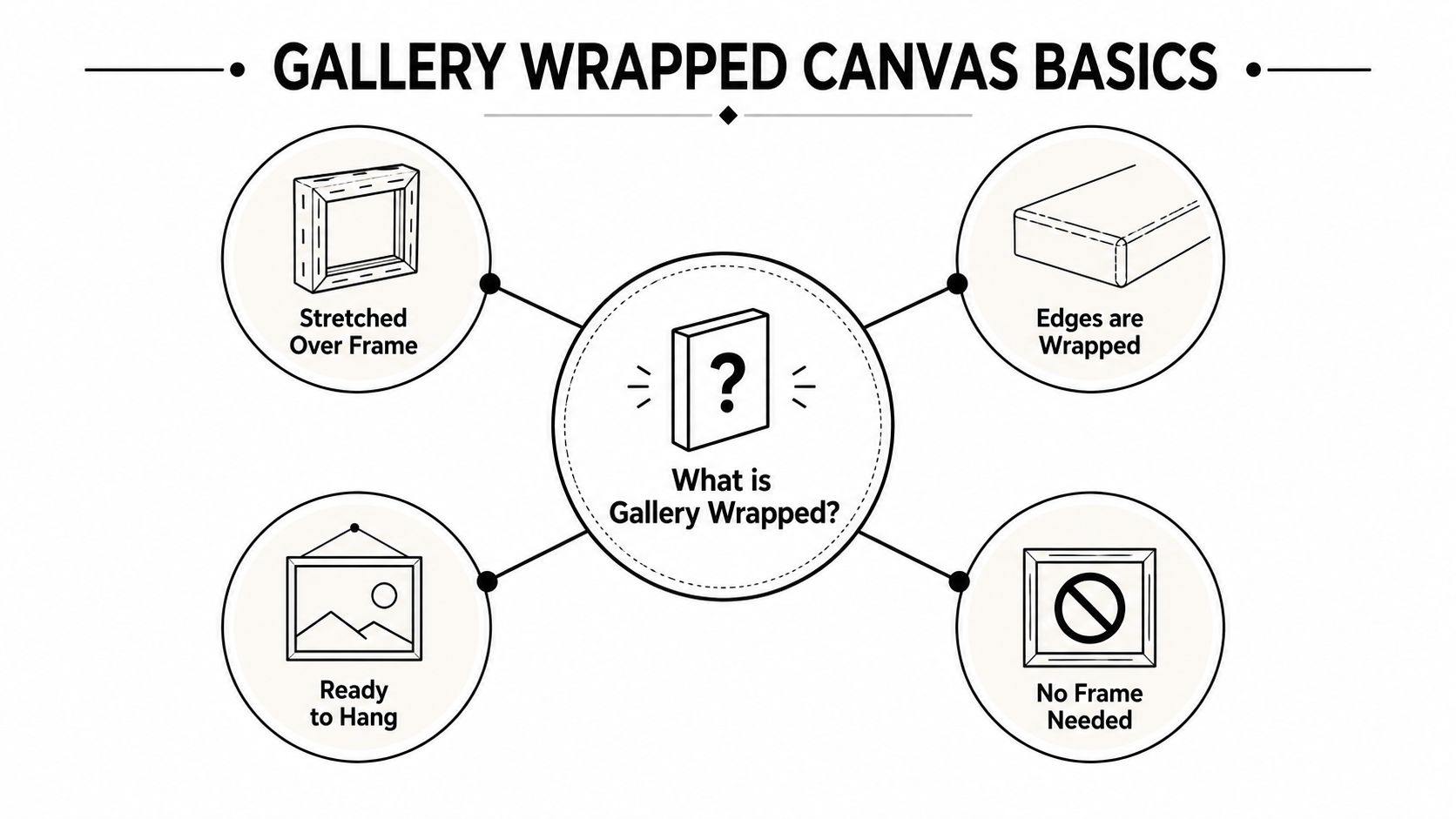
Gallery wrapped canvas is artwork stretched around 1.5-inch-deep wooden stretcher bars, with the image continuing around the edges and the fasteners hidden on the back, so it arrives as a frameless, ready-to-hang piece. That's why it feels finished the moment you unpack it, especially when you've ordered Brooklyn wall art and want it on the wall without a framing detour.
You open the box, peel away the packing, and the first question hits fast, what exactly am I looking at, and do I need to frame it? With gallery wrap, the answer is usually no, because the format is built to stand on its own and present cleanly in a home, studio, hallway, or apartment that needs strong visual impact without extra hardware.
Understanding Gallery Wrapped Canvas Basics
You've just ordered Brooklyn wall art online, and now the box is on your table. The print looks polished right away, but the term gallery wrapped still needs translation.
What the format actually means
A gallery wrapped canvas is mounted by stretching the canvas around thick stretcher bars so the image can continue onto the edges. The back stays neat because the fasteners are hidden there, which is part of what gives the piece that clean, museum-style finish. Independent and institutional descriptions commonly use a side depth of about 1.5 inches, 38 mm for this format, and that depth is treated as a minimum in exhibition criteria for gallery-wrap acceptance (gallery wrap reference).
That depth matters because it changes how the art reads on the wall. A thinner studio-stretched canvas can look more like a practical print, while a gallery wrap looks more like a finished art object. The cleaner profile is a big reason the format became so common in contemporary wall art and ready-to-hang displays (exhibition criteria PDF).
Practical rule: if the side profile looks complete without an outer frame, you're looking at the visual logic of gallery wrap.
What you should notice when it arrives
The front should feel crisp, the sides should look intentional, and the image should flow around the edge rather than stopping abruptly. Some pieces use the artwork itself on the sides, while others leave a solid edge for a more minimal look. That choice changes the mood, but the core idea stays the same, the canvas is meant to be seen as a finished surface, not as something waiting for a frame.
For a Brooklyn collector, that matters because the subject often carries enough energy on its own. Street signs, transit cues, neighborhood typography, and pop-art borough imagery don't need much help from extra framing. A good place to browse a similar ready-to-hang presentation is the Slone Brothers Furniture art collection, where the format can be studied as part of a broader wall-art setup.
Construction Details That Define Quality
A strong gallery wrap starts with the materials, not the artwork file. The surface, the wood, and the way the edges are finished all shape how the piece looks on day one and how well it holds up later.
Materials and structure that matter
Commercial gallery-wrap products commonly use 10 oz cotton canvas on pine wood stretcher bars, and professional providers often offer depths such as 1.5 inches or 2.5 inches to control rigidity, the shadow line, and how much image must wrap around the edge (materials and depth reference). Deeper bars usually create a stronger dimensional presence, which is one reason they read so well on exposed brick and other visually busy walls.
That doesn't mean every deeper canvas is automatically better. It does mean the structure should feel deliberate, taut, and proportioned to the image. A Brooklyn skyline, subway-inspired print, or bold neighborhood graphic often benefits from a deeper edge because the piece can hold its own in a room with furniture, texture, and architectural detail.
Good construction feels simple from the front. The real work is in the stretch, the corners, and the hidden back.
Edge treatment and why it changes the final look
Production guides also use the idea of bleed. That means the image extends past the trim line so it can fold around the side without cutting off important content. A no-bleed version leaves a white or colored edge visible on the side panels (bleed and edge treatment guide).
For buyers, the design decision becomes practical. If your artwork has text, a face, or a key landmark too close to the edge, a bleed can hide too much. If the composition is abstract, atmospheric, or patterned, wrapped edges can look elegant. The choice isn't about right or wrong, it's about what survives the fold with the most grace.

Gallery Wrapped Canvas Versus Framed Prints
This is the question most first-time buyers really mean. They're not only asking what gallery wrap is, they're asking whether it's the better choice for a real home, with real dust, real humidity, and real traffic.
| Factor | Gallery Wrapped Canvas | Framed Print |
|---|---|---|
| Visual style | Frameless, modern, and clean | More traditional and defined |
| Ready to hang | Usually yes, with no extra frame needed | Often needs frame selection and assembly |
| Maintenance | Dust the canvas surface carefully | Glass or acrylic can be wiped more easily |
| Edge protection | Edges can be exposed to bumps | Frame adds a protective border |
| Humidity sensitivity | Canvas can respond to moisture over time | Frame and cover can add a layer of separation |
| Best for | Contemporary rooms, casual living spaces, Brooklyn-themed statement art | Formal rooms, archival presentation, classic interiors |
A framed print gives you a boundary. The glass or acrylic cover protects the image surface and can make cleaning easier in some settings. Gallery wrap trades that cover for immediacy and visual freedom, which is why it feels so open and contemporary in a living room or hallway.
How to think about the trade-off
If you want the art to look like it's part of the architecture, gallery wrap usually wins. If your priority is layered protection, a frame has an advantage. In high-traffic spaces, the exposed edges of a canvas deserve a little more care, especially near doors, corners, or narrow passages where bags, elbows, and furniture can brush against it.
Humidity matters too. Canvas can react to moisture differently than a framed print behind glass, so a bathroom, damp basement, or poorly ventilated entryway calls for more caution. None of that makes gallery wrap fragile, it just means placement matters more than buyers sometimes assume.
The best choice depends less on trend and more on how the room behaves every day.
Choosing the Right Size and Orientation

A Brooklyn-inspired canvas can look sharp at one size and get lost at another. The art has to fit the wall, the furniture below it, and the distance from which people will see it.
Start with the wall, not the artwork
Measure the open wall area first, then judge the visual weight. A small piece can disappear above a long sofa, while an oversized print can crowd a narrow hallway or entry. The Brooklyn wall art that works best often matches the energy of the space, a compact street-sign study for a tight nook, a bold transit graphic for a feature wall, or a square composition for a balanced gallery wall.
If you're choosing between portrait, wide, and square, let the subject lead. Portrait feels strong for tall signage or stacked compositions. Wide formats work beautifully for skyline views, broad typographic layouts, and art that needs room to breathe. Square can feel especially intentional in grouped arrangements.
Use depth as part of the scale
The deeper the stretcher bars, the more presence the piece can have. A 1.5-inch profile feels substantial without overwhelming most rooms, while a deeper profile can make the art read almost sculptural on the wall (gallery-wrap depth reference). That matters in Brooklyn homes, where walls often have texture, trim, or exposed brick that already do some of the visual talking.
For sizing help, the canvas print size chart is a practical tool when you're comparing proportions before ordering. It helps when you're deciding whether a piece should anchor a room or complete it.
A gallery-wrapped canvas also needs to work with the rest of the room, not fight it. That is why the visual guidance in accents for AU living room walls is still helpful, because balance and contrast matter just as much in a Brooklyn loft as they do anywhere else.
Proper Care and Hanging Techniques
A gallery-wrapped canvas doesn't need complicated maintenance, but it does need a little respect. Most of the long-term care comes down to placing it well, hanging it securely, and keeping the surface clean without overhandling it.
Hanging it the right way
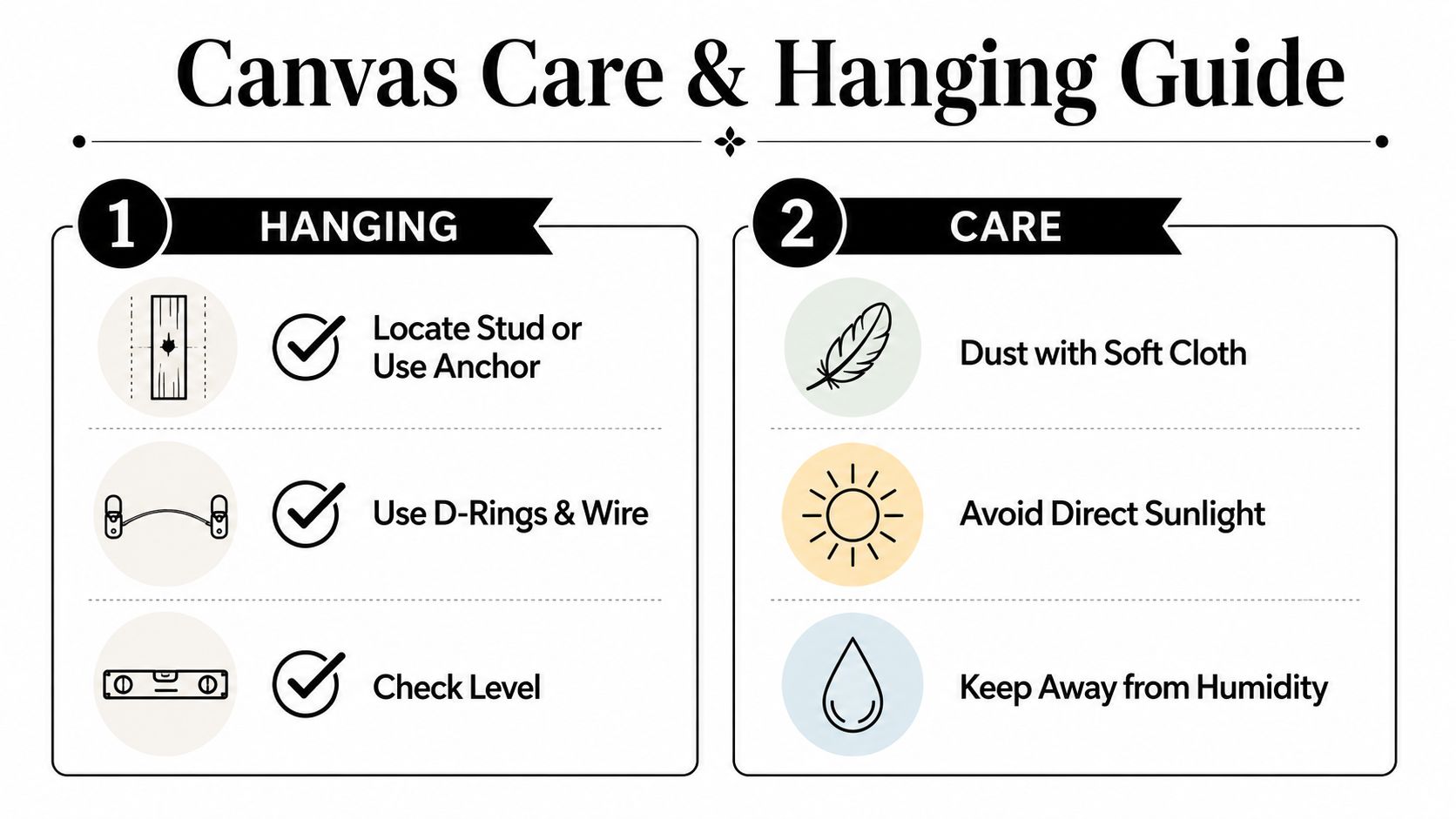
Start by locating a stud when you can, or use a proper wall anchor for the surface you're working with. D-rings and wire are common hanging hardware choices, and they help distribute weight more evenly than improvising with the wrong fastener. Before you step away, check the level one more time, because a small tilt is much easier to fix before the final nail is set.
If the wall is brick, plaster, or another tougher surface, use the anchor type suited to that material rather than forcing a standard nail into place. That matters in Brooklyn apartments, where wall conditions can vary widely from building to building.
Dust, humidity, and small wear issues
Dust the canvas with a soft cloth, not with harsh cleaners. Keep it out of direct sunlight when possible, and avoid damp or overly humid rooms for long-term display. Those are the same basic precautions that help any canvas surface stay looking fresh, but they matter more when the piece is meant to be displayed without a protective frame or glazing.
Minor dents or a little sagging don't automatically mean the artwork is ruined. In many cases, careful handling and better placement prevent the issue from getting worse. Kids, pets, and narrow walkways make edge protection especially important, so give the piece a wall location where it won't be hit constantly.
If you can dust a shelf without reaching for chemicals, you can usually care for a gallery wrap the right way.
Why Gallery Wrap Suits Brooklyn Wall Art
Brooklyn-themed art has a lot going on already, typography, transit cues, borough identity, street-level attitude, and often a strong sense of place. Gallery wrap lets that energy stay front and center instead of burying it behind a decorative frame.
The format matches the subject
A frameless presentation suits Brooklyn's contemporary visual language. Vintage street sign art, graffiti-influenced graphics, subway references, and pop-art borough pieces all feel more immediate when the image can carry across the edges and sit cleanly on the wall. The format also works well for limited-edition art because the presentation feels intentional, not generic.
That's part of why it resonates with busy New Yorkers and former residents who want something personal on the wall without turning the process into a custom-framing project. Ready-to-hang convenience matters when you're decorating a rental apartment, setting up a first home, or sending a gift that needs to look polished the moment it's opened.
The wall art gets to speak for itself
Brooklyn art often carries neighborhood pride, memory, and identity. A gallery wrap doesn't compete with that story, it clears space for it. The result feels especially right in modern interiors where the wall itself becomes part of the composition.
For readers who like seeing Brooklyn art framed in a broader design context, the ultimate guide to Brooklyn wall art offers a useful companion perspective. And if you're comparing art styles with other material-based formats, Little Green Leaf's garden art advice is a good reminder that the medium should match the setting as much as the motif does.
Smart Buying Tips for Gallery Wrapped Canvas
Look for product descriptions that tell you the depth, the canvas type, and whether the image continues around the edge. If those details are missing, the listing may be relying on style language instead of construction clarity.
What to check before you buy
- Confirm the depth: A true gallery wrap should clearly state the side profile, not just call itself “canvas art.”
- Read the edge treatment: You want to know whether the design wraps, mirrors, or leaves a solid side.
- Inspect the shipping approach: Canvas should be packed to protect corners and edges during transit.
- Review returns and support: A clear policy lowers anxiety if the piece arrives damaged or doesn't suit the wall.
- Look at the edition language: Limited-edition should mean something specific, not just sound special.
If you're comparing Brooklyn-focused releases, the limited-edition art prints page is a good model for how scarcity and series identity can be presented without making the buying process confusing. Quality matters most when the listing is specific, the photos are honest, and the seller explains what you're getting.
A good canvas should feel like a finished object, not a mystery box. If the seller makes it easy to understand the build, the size, and the edge treatment, you're far more likely to end up with wall art that looks right from day one and still feels right months later.
If you're ready to bring that Brooklyn energy to your own walls, visit The Brooklyn Initiative for limited-edition gallery-wrapped canvas art designed around the borough's streets, typography, and culture. You'll find ready-to-hang pieces that make decorating easier and more personal, especially if you want wall art that feels distinctly Brooklyn without the hassle of custom framing.