


On a warm evening in Flatbush, a rooftop tank catches the last orange light before the street below does. The silhouette is plain at first, then suddenly it reads like Brooklyn, weathered, stubborn, and still standing over the blocks.
Walk almost anywhere in the borough and you'll spot the same shape above the cornices. That wooden profile has become part of how Brooklyn looks and feels, which is why water tower Brooklyn imagery lands so hard on a wall, it already carries memory.
Why the Brooklyn Skyline Is Defined by Wooden Silhouettes
At sunset, the borough turns into layers. Brownstones darken into near-black blocks, fire escapes cut thin lines into brick, and above it all, a rooftop tank sits like a familiar punctuation mark. That shape is so ordinary that people stop noticing it, then miss it the second they leave.
Brooklyn's skyline is defined by these wooden silhouettes because they don't try to impress you. They're practical, weathered, and somehow graceful in their own rough way, which is exactly why they feel so Brooklyn. A tank on a roof says the building has lived through winters, tenancies, rent hikes, and generations of change.
The Look That Stays With You
The borough's rooftop tanks carry a visual rhythm you can recognize from a block away. Cedar slats, steel hoops, conical tops, and the slight lean of age all read like a design language that belongs to the street as much as the sky.
That's why these forms show up so naturally in Brooklyn canvas wall art. They're not just industrial objects. They're shorthand for neighborhoods, memory, and the texture of daily life, the kind of image that looks just as right above a sofa as it does above a deli awning.
Practical rule: If a rooftop shape still feels alive in a photograph, it'll usually feel alive on canvas too.
The Engineering Problem That Put Tanks on Every Rooftop
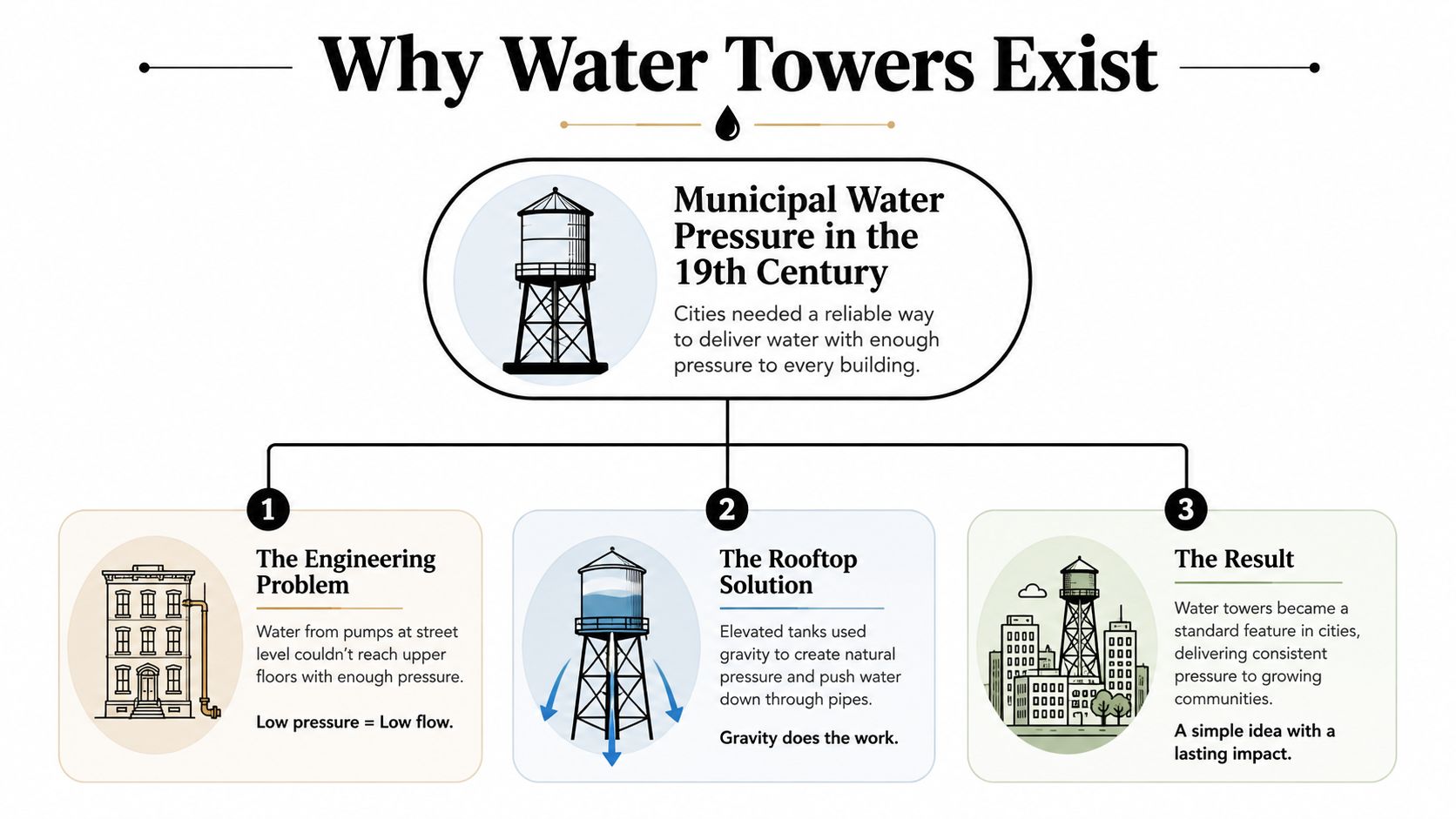
On a crowded Brooklyn block, the problem showed up where tenants felt it most. Water that reached the lower floors could lose force before it climbed to the top, and buildings were rising faster than the city's pressure could reliably serve them. A source cited by Greenpointers' overview of Brooklyn's iconic water tanks says municipal pressure could only reliably reach the fifth floor, about 60 to 75 feet in typical city conditions. For taller buildings, that meant a different system had to do the work.
Rooftop tanks answered that problem with a straightforward setup. Electric pumps moved water from the basement up to the roof, then gravity pushed it through the building's pipes whenever residents turned on a tap or demand rose. The method was simple, and it gave dense neighborhoods a dependable way to keep water moving even when the city supply fell short.
Gravity Did the Quiet Work
A rooftop tank functions as a reserve sitting above the building, ready to press water downward when demand spikes or pumps fall short. The higher the tank sits, the steadier that pressure becomes. That is why water tower storage still matters in dense cities, even when the system itself looks old-fashioned.
Brooklyn's growth made that logic visible across the borough. As mid-rise housing and commercial buildings multiplied, the tank became part of the roofline, part of the city's working silhouette, and part of the infrastructure that made dense living possible. Rosenwach, the oldest water tank company in the United States, traces its origins to 1866 on the Lower East Side, which shows how long this rooftop solution has been part of New York's built environment. The Brooklyn Initiative's archive of old Brooklyn photos helps place that history in the visual record of the city.
Water towers look poetic from the sidewalk, but their real job was always ordinary, dependable, and necessary.
The system is still easy to spot today. One modern overview reports more than 17,000 water towers across New York City, and Brooklyn's rooftops remain part of that larger pattern. Greenpointers' overview of Brooklyn's iconic water tanks captures why the form lingers in the borough's memory, and why it keeps showing up in Brooklyn canvas wall art and other home decor that borrows from the skyline.
Historic Brooklyn Water Towers and Where They Stood
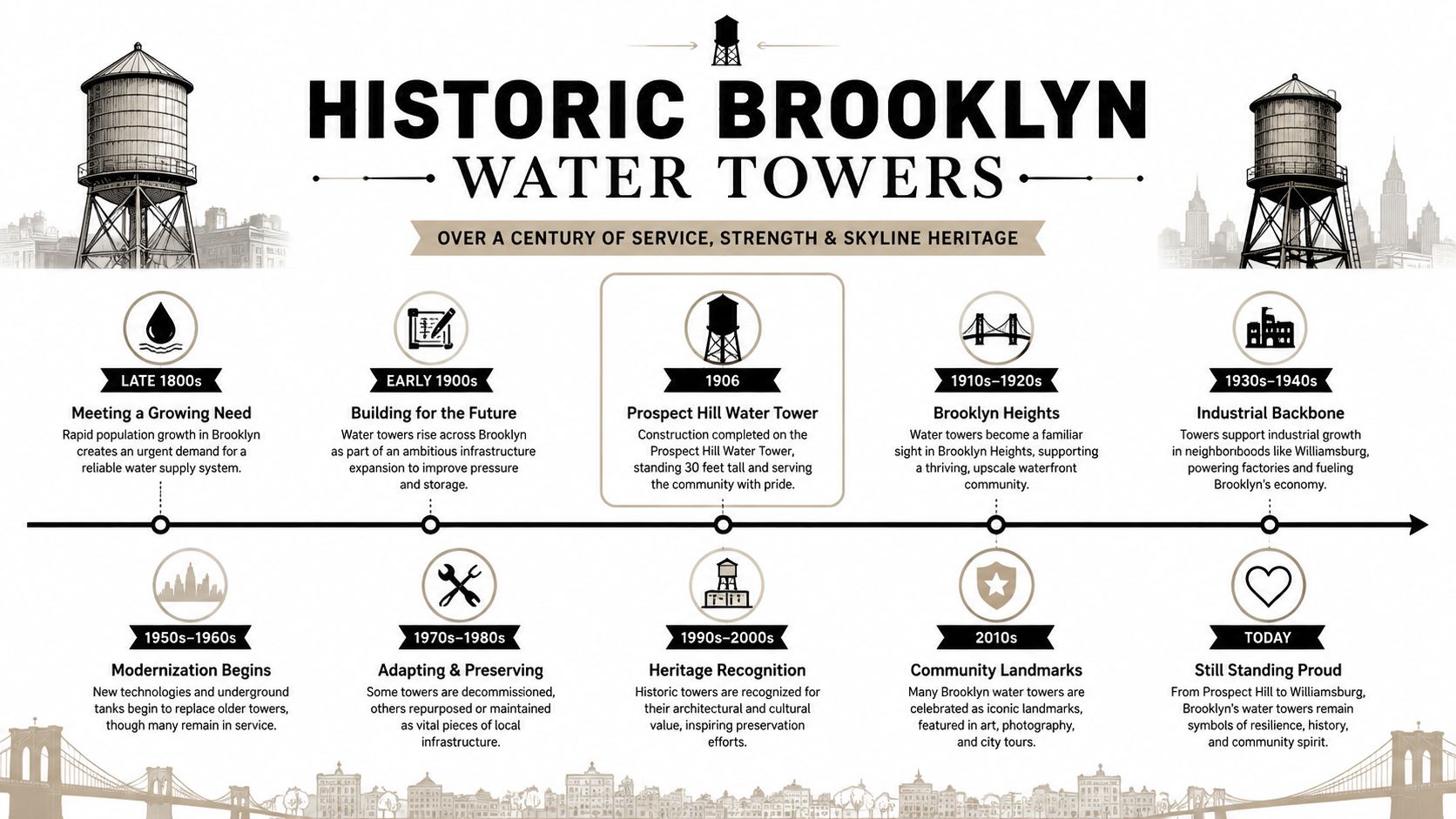
One of Brooklyn's clearest historic water-tower landmarks was the Prospect Hill Water Tower, which stood at Eastern Parkway and Flatbush Avenue beside the former Mount Prospect Reservoir. By the late 1800s, the tower was described as a 30-foot gothic structure, and the reservoir itself was 20 feet deep Urban Archive's Prospect Hill Water Tower record. The site sat inside a wider supply system that carried Brooklyn's drinking water from Long Island to a receiving reservoir in Ridgewood, Queens, then on to Mount Prospect.
The tower's story also shows how practical these rooftops could be in moments of strain. During shortages, including an acute episode in January 1893, it was pressed into service to ease water stress for residents. That detail gives the structure a different weight. It was not just something people saw from the street, it was part of the borough's day-to-day survival.
A Corner That Changed With the Borough
By 1930, the tower was demolished to make way for expansion of the Brooklyn Public Library. Brooklyn has always had a habit of trading one civic need for another, and that corner is part of that memory.
The Brooklyn Initiative's archive of vintage Brooklyn neighborhood images helps place the tower within the streets, stoops, and avenues around it. Historic rooftop forms did not sit apart from the borough's life, they belonged to the same block-by-block story that still shapes how Brooklyn feels in old photographs and in Brooklyn canvas wall art today.
Water Towers as Cultural Icons of the Borough
Brooklyn water towers have moved far beyond utility. They sit in photography, street scenes, and neighborhood memory because they tell you something about the block without trying too hard. Their presence says the building is older, the block has layers, and the borough doesn't erase its past just to look polished.
That visual honesty is part of why they fit so naturally into Brooklyn's wider culture. The same city that made graffiti, transit signage, vintage typography, and brick facades into a recognizable visual language also made the rooftop tank feel iconic. It's a shape that reads instantly, whether you grew up here or only learned the borough through albums, movies, and subway windows.
Why the Shape Feels So Brooklyn
The tower's appeal isn't sleekness. It's texture. The wooden slats, the dark bands, and the utilitarian geometry echo the borough's love of worn surfaces and practical beauty, the same instinct that makes a painted shutter, an old bodega sign, or a chipped stoop feel worth keeping.
That's also why Brooklyn wall art works best when it leans into local specifics instead of generic city imagery. A tank on a roof, a block of mid-rise brick, a street sign with neighborhood weight, these details create a visual code people recognize immediately. For a broader cultural lens on preservation and place, this piece on cultural preservation connects cleanly with how Brooklyn keeps its identity visible.
Design insight: Brooklyn imagery lands hardest when it shows the everyday structures people actually live with.
A water tower on canvas doesn't need to shout. It already carries the borough's cadence, industrial history, neighborhood pride, and a little nostalgia for rooftops people used to scan on every walk home. That's why these forms feel less like decoration and more like belonging.
Where to Spot and Photograph Brooklyn Water Towers
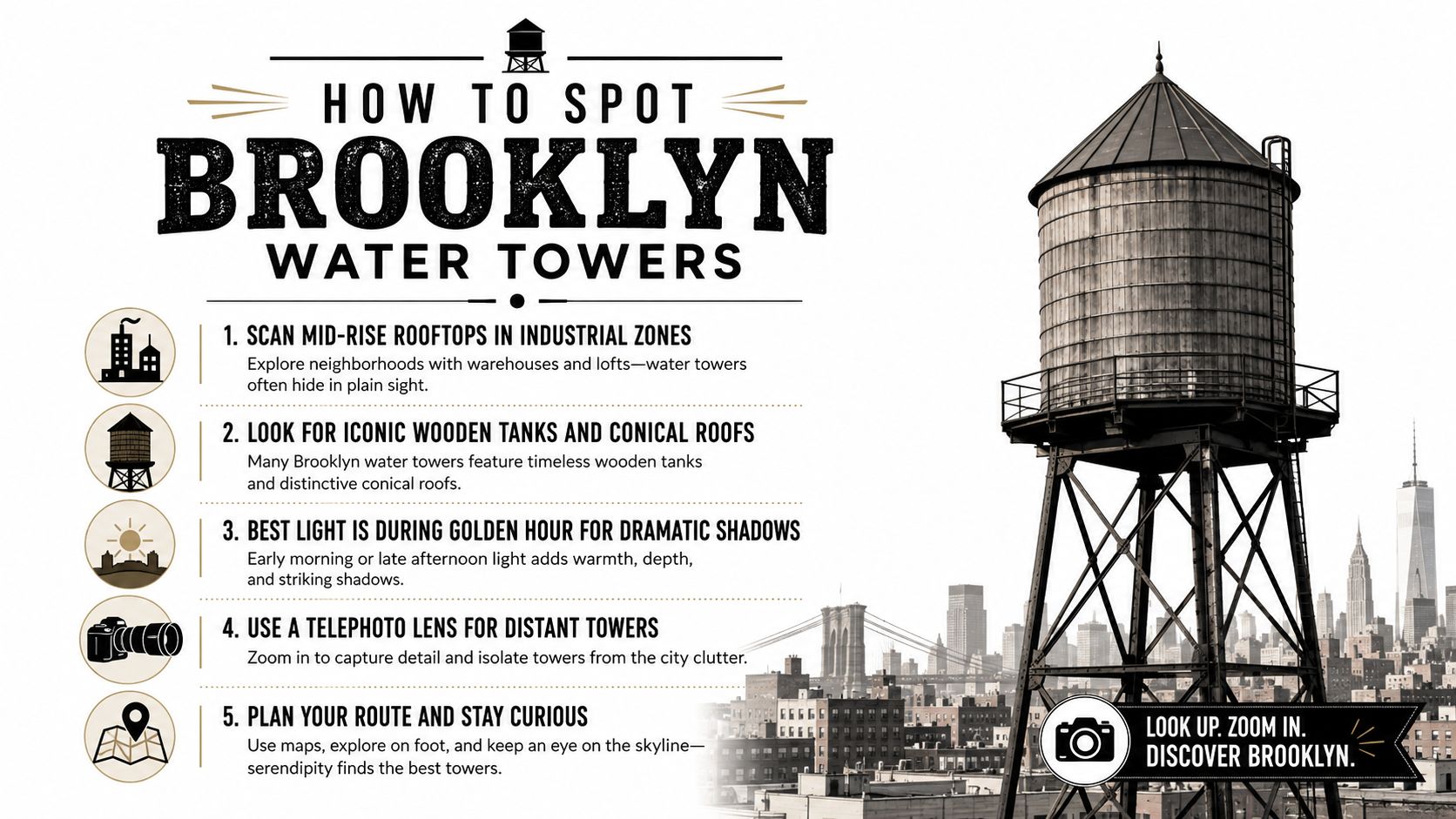
The easiest way to find a strong water-tower view is to look where older mid-rise buildings cluster. Scan rooftops in industrial zones, older residential corridors, and blocks where the skyline stays low enough for the tanks to break the roofline. Brooklyn's service gaps and neighborhood differences in the built environment also mean some areas show more of this rooftop infrastructure than others NYC Brooklyn open-space mapping context.
Golden hour is the best light for silhouette work. The wood turns warmer, the steel hoops cut sharper shapes, and the tank starts to read like a graphic object instead of a background detail. If you're shooting from farther away, a telephoto lens helps compress the block and isolate the tower against the sky.
What to Look For First
Start with the roofline itself. A conical top, a ringed cedar body, or a tower that rises just above a row of cornices usually signals a good frame. Waterfront walks, higher streets, and open park edges often give you cleaner sightlines because the foreground clutter drops away.
If you're trying to make the photo look polished rather than casual, the finish matters. MyImageUpscaler's guide to making photos look professional is useful when you want rooftop textures, sky color, and building edges to hold up in print or on a listing image.
Use the building pattern as your map. Older blocks tend to reveal more rooftop tanks because the roofline sits lower and the structures were built before today's bulkier forms.
Bringing the Brooklyn Skyline Indoors With Canvas Wall Art
A rooftop tank makes sense outdoors, but it also translates beautifully onto a wall. On gallery-wrapped canvas, the shape holds its edge without needing a separate frame, which keeps the look clean and ready to hang. That format works especially well for Brooklyn scenes because the image itself already carries the architecture, texture, and mood.
Brooklyn-themed collections often work best when they mix street-level memory with skyline detail. Vintage street signs, subway cues, graffiti aesthetics, and rooftop silhouettes all belong to the same visual neighborhood, and that's why they feel coherent in a home office, entryway, or living room. The right print can turn a wall into a small private map of the borough.
Why Canvas Fits This Subject
Canvas gives the subject a soft, tactile feel that suits weathered wood and brick. A glossy photo can make a tank feel remote, but a wrapped canvas keeps it grounded, almost as if the building itself is part of the room.
That practical appeal matters, too. People buying wall art don't want extra friction, and that's where ready-to-hang construction, lightweight durability, and easy online policies lower the barrier. The Brooklyn Initiative's storefront works in that space, with Brooklyn-focused gallery-wrapped pieces, free shipping, and a 30-day return window stated alongside featured products, which makes the format straightforward for gift buyers and first-time collectors.
If you want a fuller look at how Brooklyn imagery translates into interiors, this guide to decorating with Brooklyn-inspired artwork gives a useful design lens. The point isn't to copy the skyline, it's to bring its feeling home in a way that still feels lived-in.
Brooklyn wall art works when it feels personal, not generic. A rooftop tank, a subway line, or an old sign can carry more memory than a hundred abstract shapes.
A water tower Brooklyn print does something rare. It turns a practical rooftop object into a daily visual anchor, and it lets people keep the borough close even when they're miles away.
The Enduring Legacy of Brooklyn's Rooftop Landmarks
Brooklyn's water towers survived because the borough needed them, then kept them because people came to recognize themselves in them. The engineering solved a pressure problem, the history tied them to public health and growth, and the visual form gave the skyline a shape you can spot from blocks away.
That mix of usefulness and identity is why the towers still matter now. They remind longtime residents of old blocks, give newcomers a sense of place, and offer artists a form that's both honest and iconic. Few urban objects do all three at once.
For anyone drawn to Brooklyn wall art, that's the core appeal. The tank isn't just a rooftop object, it's a symbol of endurance, memory, and the borough's habit of turning everyday infrastructure into cultural language.
The Brooklyn Initiative designs gallery-wrapped Brooklyn canvas wall art rooted in the borough's rooftops, streetscapes, and visual memory, including the kinds of forms that make water towers unforgettable. Visit The Brooklyn Initiative to explore pieces that keep that Brooklyn skyline close at home, whether you're decorating a room, choosing a gift, or bringing a piece of the borough into your daily view.