


Picture a place where the salty air carries tales of both grit and grace, where cobblestone streets whisper stories of the past. The history of Red Hook, Brooklyn is an incredible saga of resilience. It's the story of a neighborhood forged by the very tides that shaped its destiny—from a world-class shipping port, to an industrial ghost, and finally, into the fiercely independent creative hub it is today.
This is how a community, defined by its waterfront, has time and again found the heart to reinvent itself against all odds.
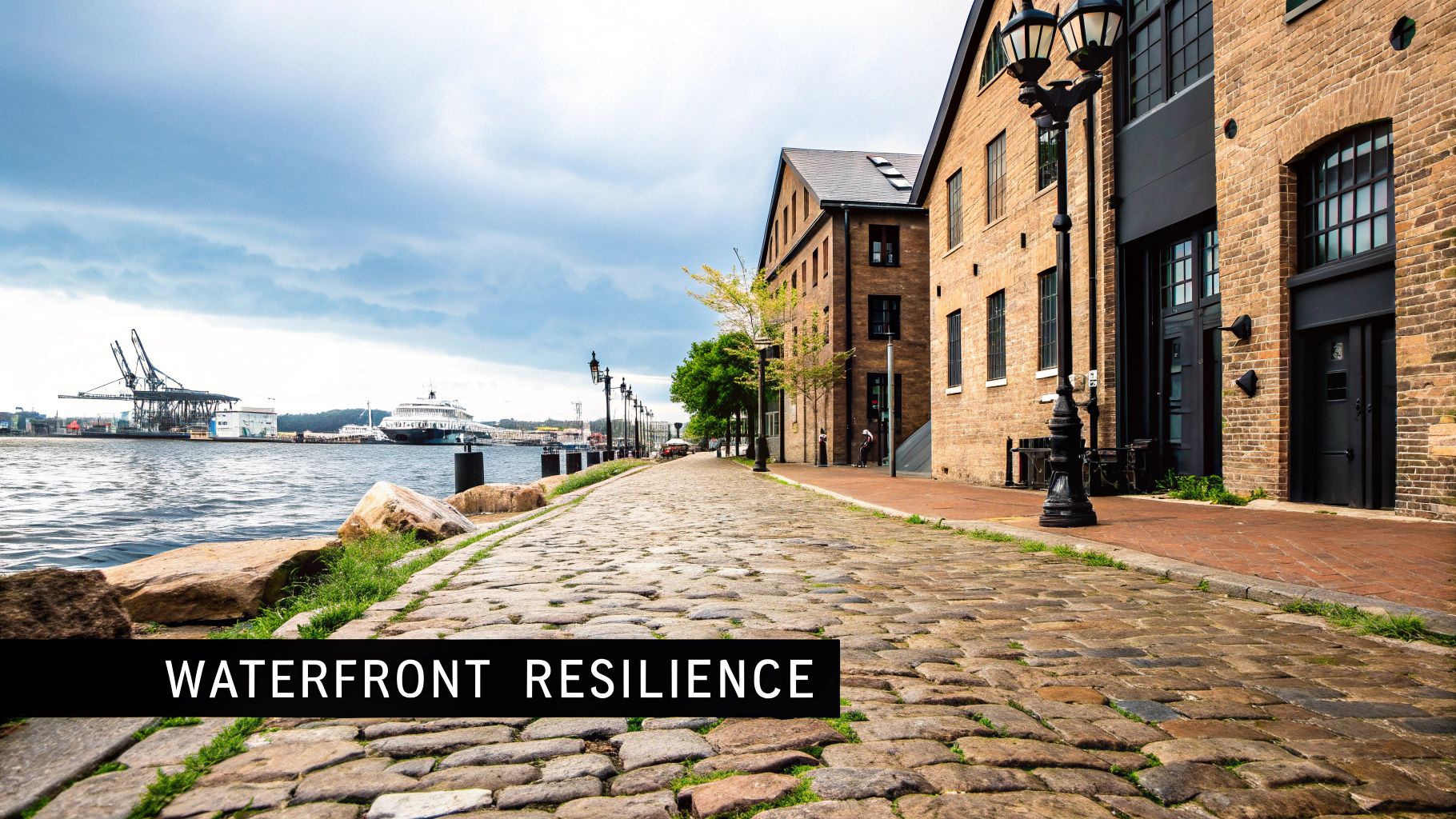
The Enduring Spirit of a Waterfront Legend
Red Hook is so much more than a spot on a map; it's living proof of a community's enduring power. Even its name is a nod to its roots, a blend of the Dutch word “Hoek” (meaning 'point' or 'corner') and the rich, red clay soil that once covered the land. This small peninsula, jutting proudly into New York Harbor, was always destined to have a story as unique as its geography.
From the very beginning, this was a place of dramatic change. What started as swampland and tidal marshes was painstakingly shaped by human hands into a maritime juggernaut. It even played a little-known but crucial role in the American Revolution, as the site of Fort Defiance, from which General Washington observed the devastating Battle of Brooklyn.
Its prime location and deep-water basins turned it into an engine of global commerce in the 19th century. This boom drew workers from all over the world who put down roots, built families, and forged a tough, close-knit identity that still defines the neighborhood.
A Story of Cycles and Reinvention
The narrative of Red Hook is one of dramatic peaks and valleys. Its golden age as a bustling port eventually faded as new shipping technologies and shifting trade routes left its piers hauntingly quiet. For a long time, it felt forgotten—physically and culturally cut off from the rest of the borough.
Red Hook’s journey is a powerful reminder that a neighborhood’s character isn’t just defined by its good times, but by its ability to endure hardship and emerge with its spirit intact. It’s a story of grit, creativity, and the refusal to be erased.
Yet, it was in that very isolation that the seeds of a new identity began to sprout. Artists, makers, and entrepreneurs, drawn by the raw beauty of its industrial landscapes and affordable spaces, saw possibility where others only saw decay. They didn't try to erase the past; they built right on top of it, turning forgotten warehouses into vibrant studios, distilleries, and workshops.
The following table gives a quick look at the major eras that have sculpted this one-of-a-kind neighborhood.
Red Hook's Transformation At a Glance
| Era | Defining Chapter | Cultural Impact |
|---|---|---|
| Early History | From Dutch settlement to a vital Revolutionary War fort. | Established its strategic importance and independent identity. |
| Maritime Heyday | A 19th-century global shipping and industrial powerhouse. | Forged a tough, working-class, and diverse immigrant community. |
| Mid-20th Century | Decline due to new shipping methods and isolation. | Became a "forgotten" neighborhood, but fostered deep local ties. |
| Modern Rebirth | An influx of artists and artisans revitalizes the area. | Became a hub of creativity, craft, and independent businesses. |
Each chapter, whether boom or bust, added another layer to Red Hook's character, creating the eclectic, resilient community we see today.
This spirit of reinvention is what truly defines modern Red Hook. It’s a place that proudly wears its history on its sleeve, where you can feel the echoes of its maritime past while surrounded by a thoroughly contemporary creative energy.
As we dive deeper into Red Hook's history, you'll see just how much it stands apart. For a wider view of what makes each corner of this borough so special, our guide to Brooklyn neighborhoods is a great place to start your exploration. This is the story of how a small corner of Brooklyn became an inspiration.
The Rise of a Maritime Powerhouse
Before it was a haven for artists and entrepreneurs, the story of Red Hook, Brooklyn was written in saltwater and sweat. Picture this: it’s the mid-1800s, and this small peninsula isn’t just another part of Brooklyn—it’s a global center of commerce. The air is thick with the smell of roasting coffee and sweet molasses, the docks are a chaotic symphony of languages, and the horizon is a forest of masts from ships arriving from every known corner of the world. This was Red Hook in its prime.
The neighborhood's transformation from sleepy marshland to an economic engine was astonishing, fueled entirely by ambition and ingenuity. It all started with the construction of two massive, deep-water basins: the Atlantic Dock in 1846 and the Erie Basin in 1864. These weren't just docks; they were gateways to the world, engineered marvels capable of sheltering hundreds of vessels at once.
This era forged a truth that still rings true today: Red Hook’s destiny has always been tied to its waterfront. It was a place built by relentless work, creating a community defined by its toughness, resilience, and an unbreakable bond with the sea.
This shipping boom drew waves of immigrants chasing the promise of a better life. Irish, Italian, and Scandinavian families poured in, finding grueling but steady work as longshoremen, shipbuilders, and warehouse workers. Their collective grit turned the gears of a global trade machine, handling everything from sugar and grain to the raw materials that built New York City itself.
The People Who Built the Docks
But the real story isn’t found in old shipping logs—it’s in the families who put down roots here. They carved out a life on the cobblestone streets, creating a cultural mosaic that was uniquely Red Hook. Each community brought its traditions, its food, and its language, forging a powerful, close-knit identity amidst the industrial grit.
Life was tough, no question about it. Everything revolved around the demanding, unpredictable rhythm of the docks. Yet, that shared struggle created an incredible sense of community. Neighbors truly relied on each other, weaving a social fabric as strong as the steel hulls of the ships they unloaded. This period cemented the Red Hook Brooklyn history as one built by ordinary people doing extraordinary things, together.
This spirit of immense collective effort was a hallmark of Brooklyn's growth at the time. Just as ambitious engineering created the docks, other monumental projects were shaping the borough. You can see that same grand vision at work by reading about the history and facts of the Brooklyn Bridge, another incredible testament to the era.
A Legacy Carved in Stone and Steel
You don’t have to look far to see the remnants of this golden age. The immense brick warehouses that still line the waterfront stand as silent monuments to the neighborhood's industrial might. Walk past them, and you can almost hear the echoes of the past—the groan of cargo cranes, the shouts of dockworkers, and the low hum of a neighborhood at the center of the world.
This maritime era did more than just build an economy; it forged a character. It created a place that understood the value of hard work, the power of community, and the art of reinvention. The sweat and determination of those early residents laid the foundation for the creative and fiercely independent spirit that would define Red Hook for generations, proving that its toughest times would only make its story more inspiring.
A Neighborhood Divided by Concrete and Steel
The mid-20th century brought a new kind of storm to Red Hook. This one wasn't made of wind or rain, but of concrete and steel. The neighborhood had been built on the back of a bustling maritime trade, but its future was about to be violently reshaped by the grand—and often destructive—vision of urban planner Robert Moses. What came next wasn't just construction; it was a deep, painful tear in the community's social fabric.
This period became a truly difficult chapter in Red Hook Brooklyn history. It was a time when the demands of a city in motion were placed far above the soul of a neighborhood that just happened to be in the way. For the families who called these streets home, progress felt a lot less like a promise and a lot more like a threat.
The vision was monumental: forge new arteries to feed the heart of New York City. The Gowanus Expressway and the Brooklyn-Battery Tunnel were hailed as incredible feats of engineering, designed to move traffic and connect the boroughs like never before. But for Red Hook, this connection came at the price of being profoundly cut off.
The Human Cost of Urban Renewal
These massive projects weren't built in empty lots; they were carved right through the center of a living, breathing community. Streets that once echoed with the sounds of kids playing and neighbors talking were condemned. The path of progress, as drawn on Moses's maps, ran straight through homes, shops, and local spots that had been there for generations.
The construction of the Gowanus Expressway and the Brooklyn-Battery Tunnel along Hamilton Avenue and Hicks Street was like drawing a thick, permanent line through the neighborhood. This single act physically and socially severed what had been a tight-knit, working-class community. Dozens of blocks were flattened, and thousands of residents were forced from the only homes they'd ever known. Across the city, Moses's projects uprooted an incredible number of families—some estimates say over 250,000 New Yorkers were displaced by the time he was done. You can see the lasting impact of these decisions by exploring the history of segregation by design.
This wasn’t just about losing buildings; it was about losing a way of life. The projects created a concrete wall, isolating Red Hook from the rest of Brooklyn and turning a once-connected peninsula into a forgotten island.
The infographic below shows the stark reality of this urban divide, illustrating just how the expressway sliced right through the community's heart.
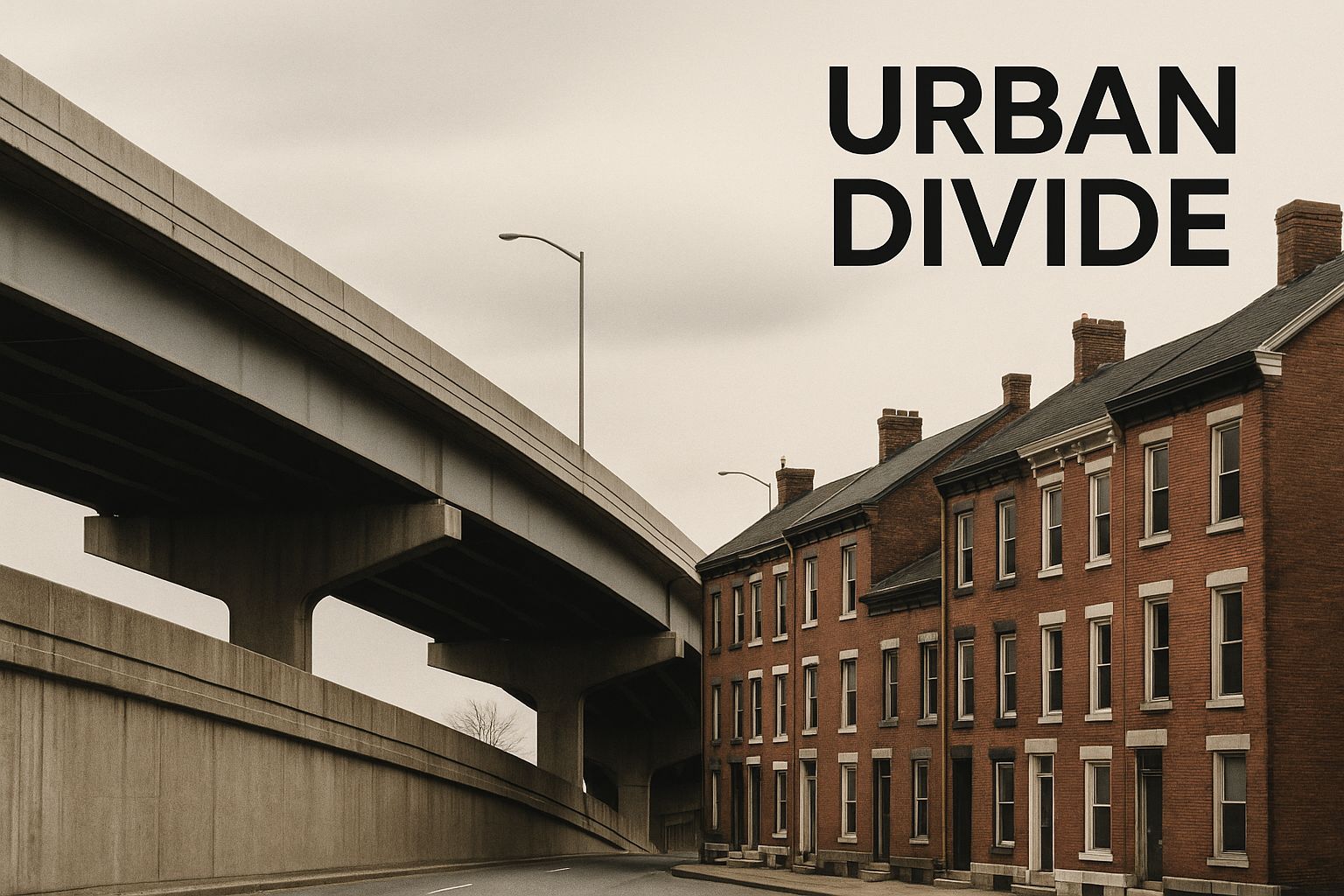
This image captures the exact moment a neighborhood was cleaved in two—a powerful visual of the isolation that would come to define Red Hook for decades.
A Community's Fight for Survival
Faced with this overwhelming force, the spirit of Red Hook bent, but it didn't break. The residents who stayed found themselves living in the shadow of the very structures that had fractured their world. They were suddenly cut off from public transit, from jobs, and from the rest of a city that seemed to be moving on without them.
But something incredible happened. This forced isolation sparked an even stronger sense of self-reliance and community. People had to lean on one another in new and deeper ways. The struggle to survive became a rallying cry, strengthening the bonds between neighbors who simply refused to let their home be erased from the map.
This era of division is a painful but essential part of Red Hook's story. It set the stage for the decades of hardship that followed, but it also forged the resilience that would eventually ignite the neighborhood's creative and cultural rebirth. It's an inspiring tale of a community that, when faced with erasure, chose to fight for its future, proving that its heart was far stronger than concrete and steel.
When the World Looked Away
From the 1970s through the 90s, Red Hook felt like it had been cut loose from the rest of New York City. First came the Gowanus Expressway, a concrete wall that physically walled the neighborhood off. But what followed was a slower, quieter kind of isolation that cut even deeper.
The world of shipping was changing, and Red Hook was on the wrong side of history. The age of the massive container ship had dawned, and these new giants of the sea needed huge, modern ports with sprawling yards and towering cranes. Red Hook's old-school, finger-like piers simply couldn't keep up. The jobs that had been the community's lifeblood for generations began to dry up, seemingly overnight. The docks, once a chaotic symphony of work, fell eerily silent.
That silence left a void. Without its economic engine, Red Hook truly became a forgotten peninsula, a chapter of Red Hook Brooklyn history defined by being left behind.
The Toughest Years
When the jobs left, desperation moved in. As the neighborhood's infrastructure was left to crumble, crime began to take root and climb. By the late 80s and early 90s, Red Hook had earned a grim national reputation as one of the city's most dangerous places—a neighborhood where just getting by was a daily battle.
The numbers tell part of the story. The U.S. census shows Red Hook's population fell from 10,659 in 1990 to only 9,918 by 2000. The headlines told the rest. LIFE magazine notoriously dubbed it the 'crack capital' of America, a label that stuck. At the same time, the community's very makeup was shifting. Between 1990 and 2010, the Black population shrank from 5,311 to 3,703, while the White population more than doubled from 812 to 1,740. You can explore more about these demographic changes to see the full picture.
It was an incredibly difficult time, but this is also where the true spirit of Red Hook was forged in fire.
"When the world turned its back, Red Hook learned to rely on itself. It was in these decades of neglect that the community’s fierce independence and unwavering resilience became its greatest assets, proving that a neighborhood’s heart is something that can't be demolished or forgotten."
The families who stayed behind did so out of pure grit. They loved this place, and they refused to let the headlines or the decay define them. They just held on, carving out their own self-sufficient world on their small patch of waterfront.
The Unbreakable Spirit of Community
With the city largely absent, residents became their own advocates, their own protectors, and their own source of hope. They organized, they fought for what was theirs, and they looked out for one another in a way that people in more prosperous neighborhoods never have to.
This long struggle gave rise to a powerful sense of place that you can still feel today. It’s in the fiercely independent spirit of the local businesses and in the way neighbors still know each other by name. This survival was built on a few core truths:
- Deep-Rooted Family Ties: Many families had been here for generations. That history created a social fabric woven from shared memories and trust, a safety net when there was no one else to catch them.
- Creative Self-Reliance: When you have little, you learn to make the most of everything. People found ways to create their own opportunities, from planting community gardens in abandoned lots to forming informal neighborhood watch groups to keep the streets safe.
- Preservation of Culture: Through it all, they never let the soul of the neighborhood die. Block parties, local traditions, and community events became small acts of defiance—a way of shouting, "We are still here."
This period, as dark as it was, wasn't an ending. It was a painful but necessary fire that burned the neighborhood down to its studs. In a strange way, the very isolation that hurt Red Hook also protected it, sheltering its raw, authentic character from the waves of gentrification that were already washing over other parts of Brooklyn.
The story of these decades isn’t about being a victim. It's an incredible story of strength. It's a testament to the families who refused to give up, who held the line, and who made sure that when the tide finally began to turn, there was still a Red Hook left to save.
The Creative Rebirth of an Industrial Relic
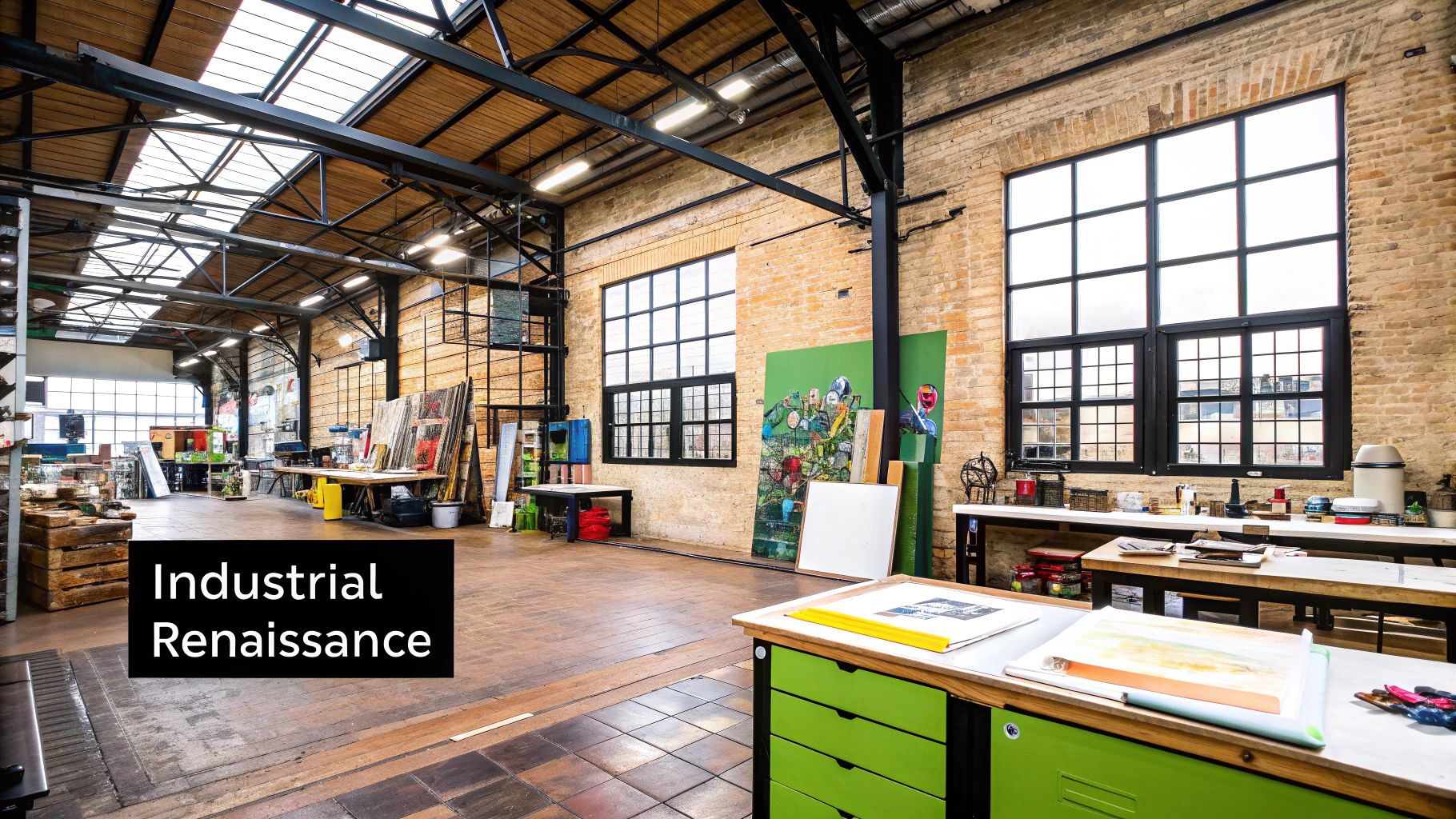
Where most people saw only rust and decay, a new generation of pioneers saw a blank canvas. As the 20th century wound down, Red Hook’s years of neglect had ironically preserved its greatest asset: its industrial soul. Those vast, empty warehouses and quiet cobblestone streets—once symbols of decline—started whispering to a different kind of dreamer.
Artists, artisans, and innovators, squeezed out of other rapidly gentrifying corners of New York, found themselves drawn to the neighborhood’s raw, unvarnished character. They weren't after polished lofts or trendy cafes. They were looking for space, light, and the freedom to build something from scratch. This was the start of a vibrant new chapter in the Red Hook Brooklyn history, one fueled by imagination instead of cargo.
This wasn't some top-down, corporate redevelopment. It was a grassroots renaissance, built from the ground up. It was the quiet hum of a woodworker's saw echoing in a former shipping depot, the bright flash of a welder's torch behind a long-shuttered garage door. The creative energy was electric, spreading from one block to the next.
Finding Beauty in Industrial Bones
The pioneers of this new era didn't bulldoze the past—they built upon it. They knew the history baked into the brick and steel was the source of the neighborhood's power. Old factories weren't problems to be solved; they were opportunities, with their soaring ceilings and cavernous floors just waiting to become ambitious art studios, workshops, and performance spaces.
The very isolation that had once hobbled Red Hook now served as a protective cocoon. Shielded from the frantic pace of the rest of the city, a uniquely self-reliant and creative culture began to take root. This new community was founded on a shared spirit of ingenuity and a profound respect for the area’s blue-collar heritage.
It was a story of transformation, not erasure. The new wave of residents saw the beauty in the industrial relics, honoring the grit of the past while using it as a foundation for a vibrant, creative future.
This movement wasn't just about art; it was about craft. A deep sense of artisanship took hold, with makers dedicating themselves to producing things by hand with incredible skill and care.
The Rise of the Maker Culture
Before long, Red Hook became a destination for high-quality, locally made goods. The same waterfront that once unloaded sugar and coffee from across the globe was now home to businesses creating products that would earn worldwide acclaim. This "maker movement" was incredibly diverse:
- Distilleries and Breweries: Entrepreneurs fired up stills and fermentation tanks in old warehouses to craft award-winning whiskeys, rums, and beers, reviving a rich American tradition of spirits.
- Artisanal Food Production: Chocolatiers, bakers, and even a now-famous key lime pie maker set up shop, drawing foodies from across the five boroughs and beyond for a taste of something truly authentic.
- Custom Furniture and Design: Woodworkers and metalworkers found the sprawling spaces they needed to build gorgeous, handcrafted furniture and custom fixtures, elevating industrial skills into high art.
These weren't just businesses; they were destinations. They brought a new energy to the streets, attracting visitors who wanted to meet the people behind the products they admired. Every new workshop that opened felt like another light switched on in a neighborhood that had been dark for far too long.
This rebirth was far from perfect, and it came with its own set of challenges. At its heart, though, it’s an inspiring story of how creativity can reclaim and redefine a place. The artists and makers who came to Red Hook didn’t just find cheap rent; they found a home with a history that echoed their own values of resilience, hard work, and fierce independence. They saw the neighborhood's soul and, in turn, helped give it a new one.
Red Hook Today: A Balance of Progress and Preservation
Walk through Red Hook today, and you’ll feel it instantly—a neighborhood caught in a beautiful, delicate dance between its tough-as-nails past and a future bursting with new energy. On one cobblestone corner, you see the resilient spirit of its history etched into the brickwork. On the next, you feel the vibrant hum of its creative rebirth. This is the living, breathing final chapter of the Red Hook Brooklyn history—a story not of endings, but of constant, thoughtful evolution.
The neighborhood is navigating the powerful currents of change. The arrival of big-box stores and gleaming new developments brings both opportunity and a familiar sense of unease. Long-time residents and recent arrivals alike are grappling with gentrification and rising costs, all while fighting to hold onto the raw, authentic character that makes Red Hook so magnetic.
This balancing act is the very heart of the community’s modern struggle, and it’s also its greatest inspiration. It’s a collective, often messy, effort to grow without losing your soul.
The Echoes of Hurricane Sandy
Hurricane Sandy in 2012 was a defining moment for this new era. The storm was a devastating reminder of Red Hook’s vulnerability as a low-lying peninsula, submerging homes and businesses under feet of floodwater. But what happened next was a powerful testament to the neighborhood's unbreakable spirit.
In the chaos, neighbors mobilized. They checked on each other, shared resources, and started rebuilding, proving that the bonds forged through decades of isolation were far stronger than any storm surge.
In the aftermath, Red Hook didn’t just rebuild; it became a leader in climate resilience. The community has worked to build smarter, putting in place everything from flood walls to elevated parkland to protect their home. This fight against the tides is just a modern version of the same tenacity that has always defined this waterfront town.
Preserving Culture Amidst Change
The core challenge for Red Hook today is protecting its unique identity. It’s a conversation happening in real-time on its streets: how do you welcome new energy without displacing the old guard? How can you support new businesses while making sure the neighborhood remains a place for everyone? The answers are being forged in a shared commitment to what makes Red Hook, Red Hook.
Red Hook’s future is being written by those who honor its past. It’s a powerful lesson in how a community can face progress not with fear, but with a fierce determination to protect its identity and guide its own destiny.
This process demands a deep respect for the area’s heritage. The conversation around what cultural preservation truly means is vital, as residents work to ensure the stories and landmarks of their past are not paved over by shiny new facades. It’s about keeping the neighborhood’s soul intact for the next generation.
Interestingly, this pattern of growth isn't isolated. Though it's a different town entirely, Red Hook, New York, offers a compelling parallel. Between 2022 and 2023, its population swelled by 16.7%, while its median household income jumped 14.6% to $104,022, pointing to similar waves of economic change. You can explore these demographic shifts on datausa.io.
Ultimately, Red Hook stands as a powerful symbol of community strength in a city that never stops changing. It honors its gritty, industrial past while thoughtfully shaping a creative and resilient future—proving that with enough heart, progress and preservation really can walk hand in hand.
Diving Deeper into Red Hook's Story
Still curious about Red Hook? Let’s tackle some of the most common questions people have about this incredible corner of Brooklyn and its one-of-a-kind history.
Where Did the Name "Red Hook" Come From?
It’s actually a beautiful, literal description straight from the Dutch settlers. The "Red" comes from the rich, reddish clay soil that was once common here. The "Hook" is an anglicized version of the Dutch word "Hoek," which simply means "point" or "corner."
So, "Red Hook" was just a straightforward name for the red-soiled point of land jutting out into the harbor.
What Put Red Hook on the Map as a Major Port?
During its golden age in the 19th and early 20th centuries, Red Hook wasn't just a port—it was a global powerhouse. Its massive, deep-water basins, like the Erie Basin and Atlantic Dock, were engineering marvels that could handle the world's biggest ships.
This prime waterfront location made it an essential engine for global trade, fueling New York City's explosive growth and cementing its place on the world stage.
Red Hook’s true story isn't just about ships and cargo; it's about pure, unadulterated resilience. It went from a world-famous port to an overlooked corner of the city, only to re-emerge as a hub of creativity. That’s the kind of spirit that truly defines a place.
What Is Red Hook Famous For Now?
Today, Red Hook is celebrated for its incredible character—a seamless blend of gritty industrial history and a fiercely independent creative culture.
It's a place known for its artisans, from craft distillers to bean-to-bar chocolatiers, and for offering some of the most breathtaking, unobstructed views of the Statue of Liberty you'll find anywhere. More than anything, it's known for a tight-knit community that has stood strong through thick and thin.
Celebrate the culture you love. At The Brooklyn Initiative, we design limited-edition graphic tees that capture the soul of Brooklyn's unique neighborhoods. Wear your story and check out our collection.